
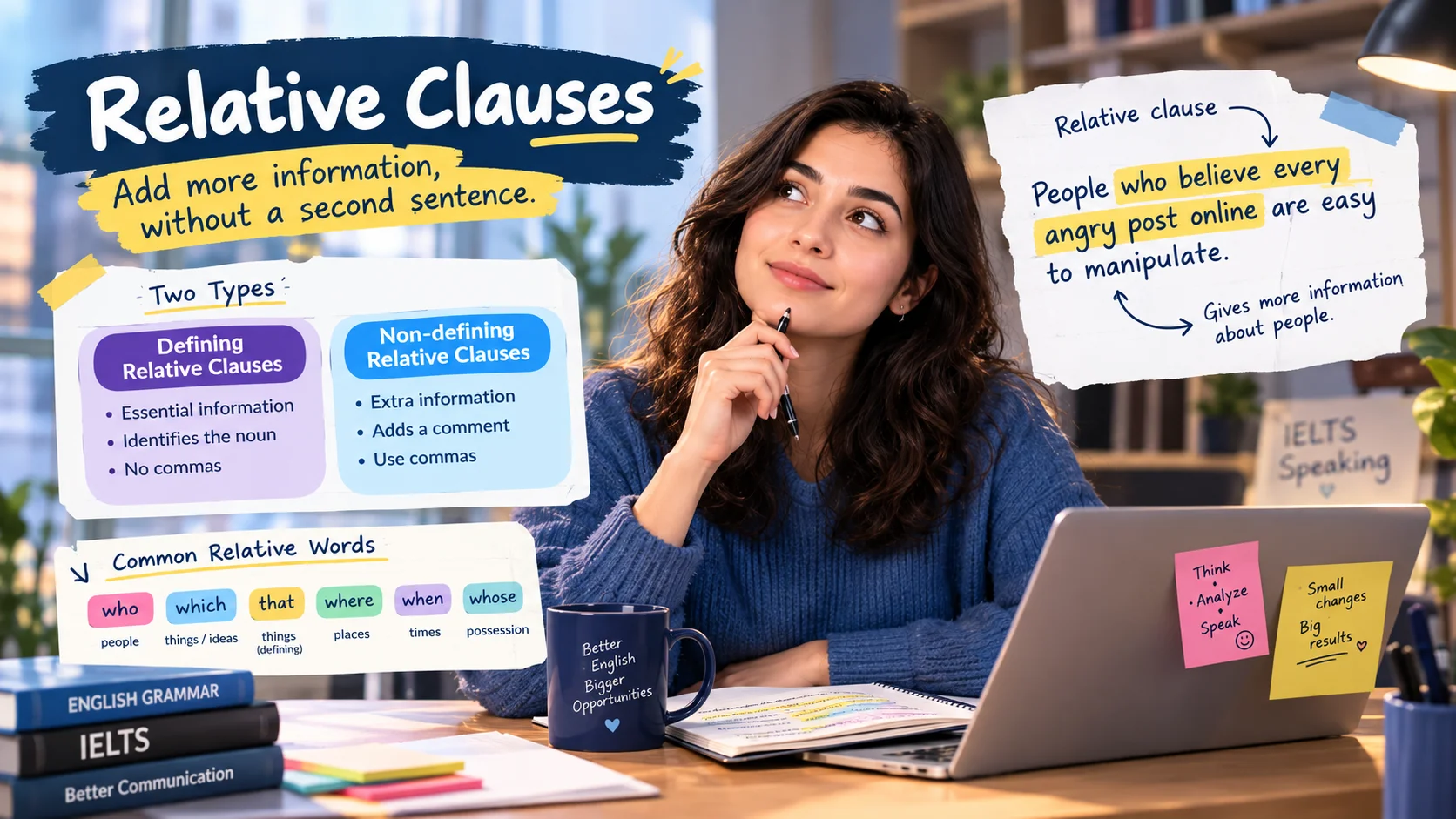
Relative Clauses
Sometimes we want to give more information about a person, thing, place, or time, but we do not want to make a second sentence. We want to add information inside a sentence.
For example,
People who believe every angry post online are easy to manipulate.
The part “who believe every angry post online” gives us more information about people.
This is called a relative clause.
Generally, when you hear ‘relative clause,’ think of a noun with more information attached to it inside a sentence.
Nouns can be known to the listener/reader, or they can be too general. That is why we have two kinds of relative clauses:
Defining relative clauses
Non-defining relative clauses
1. Defining relative clauses
A defining relative clause helps us answer:
Which one? Which person? Which thing? Which place?
Example:
People who share fake news should check sources first.
Which people?
People who share fake news.
So, the relative clause is necessary. Without it, the sentence becomes too general, insane, or stupid.
Read this: People should check sources first.
Well, yes, but which people are we talking about? Everyone? But it makes no sense. Why everyone?
More examples:
Posts that make us angry should be checked carefully.
Students who ask good questions learn better.
A website where anyone can post anything can become dangerous.
The moment when people stop thinking is the moment manipulation begins.
In these examples, the relative clause helps us identify the noun.
No commas.
2. Non-defining relative clauses
A non-defining relative clause gives extra information about a noun.
The noun is already clear for the reader/listener.
Example:
Instagram, which many people use every day, can spread fake news quickly.
We already know what Instagram is.
The part “which many people use every day” only adds extra information.
More examples:
My friend Sara, who always checks sources, rarely shares fake news.
Critical thinking, which protects us online, should be taught seriously.
Telegram, where many people read news, can spread rumors fast.
Last night, when the rumor started, many people shared it without checking.
In these examples, the relative clause gives an extra comment.
Use commas.
3. The comma changes the meaning
Compare these two sentences:
Students who question online information are harder to manipulate.
Meaning:
Only the students who question information are harder to manipulate.
Now compare:
Students, who question online information, are harder to manipulate.
Meaning:
All students question online information.
This sounds beautiful. Also, suspiciously optimistic. It sounds like someone is exaggerating ALL students’ critical-thinking abilities.
Another example:
Comments that insult people should be deleted.
Meaning:
Only insulting comments should be deleted.
Now compare:
Comments, which insult people, should be deleted.
Meaning:
All comments insult people.
Now we sound like a hard-headed theorist with a lot of pent-up anger inside.
4. Common relative words
Use:
who for people
which for things or ideas
that for things in defining clauses
where for places
when for times
whose for possession
Examples:
A teacher who listens carefully can understand students better.
A video that spreads fear can become dangerous.
Posts that attack people personally should be ignored.
A platform where anger is rewarded can become toxic.
A time when people are afraid is a dangerous time for society.
Influencers whose income depends on attention need reactions.
Important:
Do not use that in non-defining clauses.
Correct:
Social media, which rewards quick reactions, can damage thinking.
Wrong:
*Social media, that rewards quick reactions, can damage thinking.
Exercise 1: Defining or non-defining?
Write D for defining and ND for non-defining.
People who never check sources often share fake news.
My cousin, who believes every dramatic headline, shares ten posts a day.
Posts that create panic should be checked carefully.
Critical thinking, which helps us judge information, is a survival skill.
The website where the rumor started is now blocked.
Exercise 2: Add commas where needed
Add commas only when the relative clause gives extra information.
My friend Sara who checks sources before sharing rarely spreads rumors.
People who react emotionally are easy to manipulate.
Instagram which rewards attention does not always reward truth.
Comments that insult people should be ignored.
Telegram groups where people share news need careful readers.
Exercise 3: Complete the sentences
Complete each sentence with your own relative clause.
Example:
People who believe everything online become easy targets.
People who __________ should be more careful online.
Posts that __________ should not be shared quickly.
A platform where __________ can become dangerous.
Critical thinking, which __________, is important for everyone.
Influencers whose __________ may create anger for money.
Exercise 4: Write your own sentence
Use the words to make complete sentences.
Example:
comments / insult people
Comments that insult people should be ignored.
people / check sources
videos / create fear
students / ask questions
social media / rewards attention
influencers / sell outrage
Answer Key
Exercise 1
D
ND
D
ND
D
Exercise 2
My friend Sara, who checks sources before sharing, rarely spreads rumors.
No commas.
Instagram, which rewards attention, does not always reward truth.
No commas.
No commas.
Exercise 3: Sample answers
People who share news without checking should be more careful online.
Posts that make people angry should not be shared quickly.
A platform where lies spread easily can become dangerous.
Critical thinking, which helps us protect our minds, is important for everyone.
Influencers whose income depends on attention may create anger for money.
Exercise 4: Sample answers
People who check sources are harder to manipulate.
Videos that create fear should be checked carefully.
Students who ask questions learn more deeply.
Social media, which rewards attention, can spread nonsense quickly.
Influencers who sell outrage are not always honest.
I hope this has been helpful.