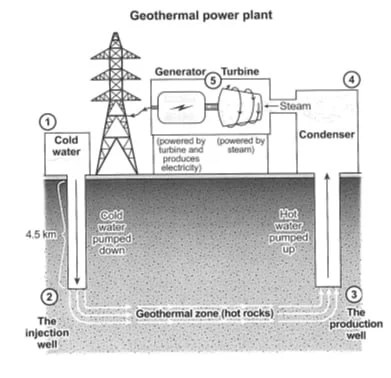
The diagram shows how geothermal energy is harnessed for electricity production in a power plant. Overall, this linear process combines engineering and natural resources and involves five steps to heat cold water through the geothermal zone under the earth and use the resulting steam to generate electricity on the ground.
The underground operation involves three steps, beginning with pumping cold water from a tank down a 4.5-km well, called the ‘injection well.’ Once the water has reached the geothermal zone, it crosses through the hot rocks, technically called a geothermal zone, and heats up. It then arrives at a second well, called the ‘production well’ (which is wider by comparison), through which it is pumped up 4.5 km into a condenser on the surface.
On the ground, the procedure consists of two steps, which begin with the condenser, whose function is to compress the steam from the hot water to be pushed through a narrow passage, creating a force that propels a turbine. The rotating turbine, which is connected to a generator with a shaft, powers it, converting mechanical energy to electricity to be delivered to the grids.