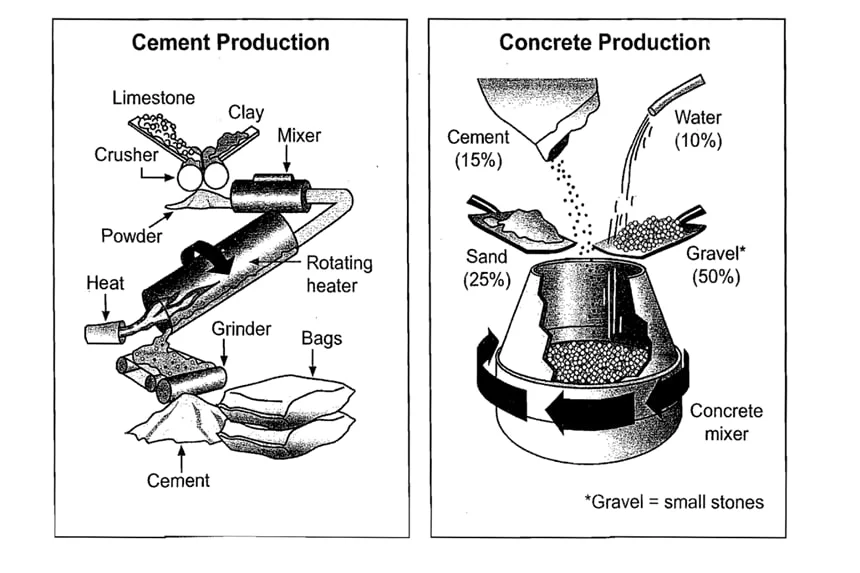
The diagrams show two processes and the required equipment for making cement and concrete for construction purposes. Overall, producing cement from limestone and clay requires a more complex procedure consisting of various steps and tools, whereas concrete production is a more straightforward operation requiring one piece of machinery and the proportional mixing of four substances, one of which is cement.
The linear multiphase method of cement making begins with limestone and clay being crushed in a machine designated as the Crusher. The resulting powder is then sent to another device labeled the Mixer. Once the powder has been mixed, it must be heated in the next phase using a tubular rotating heater. The powder enters the rotating tube at one end, and an external torch is applied to the other end. In the final phase, the resultant substance is sent to a Grinder, and cement is produced and bagged for use.
In a separate process, concrete is formed by using one piece of machinery called the Concrete Mixer. The machine rotates and mixes the required ingredients, one of which is gravel (i.e., small stones), comprising 50% of the blend. The next most considerable substance is sand, at 25%, followed by cement and water, which constitute significantly smaller proportions: 15% and 10%, respectively. The Mixer rotates on its axis, and the motion forces the four elements to fuse and result in concrete.