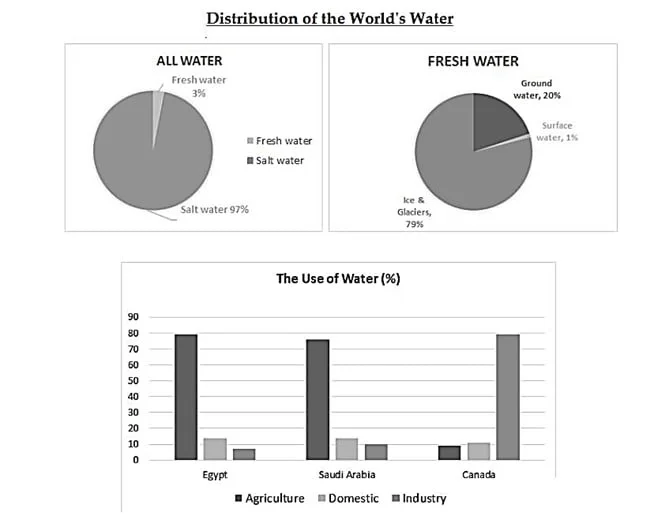
The pie charts show the global proportions of saltwater and freshwater, and the bar chart presents a breakdown of water use in agriculture, households, and industry in Egypt, Saudi Arabia, and Canada. Overall, nearly all the world’s water is saline, and the limited freshwater supply is mostly frozen in ice. The sectoral breakdown also indicates that agricultural use dominates in Egypt and Saudi Arabia, whereas in Canada, industry is the primary consumer, with domestic and agricultural use showing broadly similar figures.
Of all the water on Earth, 97% is saltwater, and the remaining 3% is fresh. Even this small proportion is not fully available, as almost four-fifths is locked in glaciers and ice. Groundwater makes up another 20%, while only 1% is surface water, including rivers, lakes and other accessible sources.
Regarding national water allocation, Egypt and Saudi Arabia follow a similar pattern: around 80% of their water is used for agriculture, with domestic use at roughly 12% and industry accounting for only 6–10%. In contrast, Canada’s distribution is markedly different. Industry is by far the major user at approximately 80%, while both agriculture and household consumption are much lower, at about 10% each.