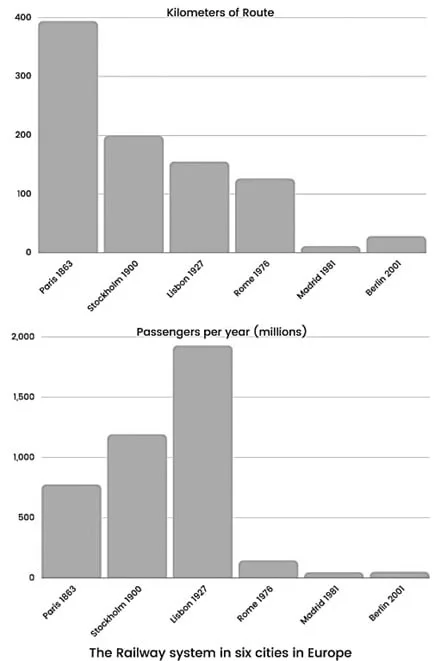
The bar charts show the subway systems in six European metropolises based on opening date, length (kilometers), and passengers (millions). The data suggest that the railways’ span positively correlates with their age, whereas passenger capacity negatively correlates with age in the three oldest railways.
Concerning the railway span, the oldest system, built in Paris in the mid-19th century, spans nearly 400km—the longest. In descending order of recency, however, Stockholm, Lisbon, and Rome, constructed in the 20th century, are two or three times shorter, followed by Madrid, which is only around 10km. The only irregularity is Berlin, the newest, which is about three times more extended than its older competitor.
The data in the second chart shows a different pattern. Paris, the oldest, carried around 750 m, a figure growing against age in more recent systems in Stockholm and Lisbon, with the latter showing a record high of almost 2000 m. Among the remaining, by contrast, the figures are notably less marked as the more recent the system is, the fewer passengers it serves. Rome, for instance, carried merely about 200 m, followed by about three times less significant rates in Madrid and Berlin.