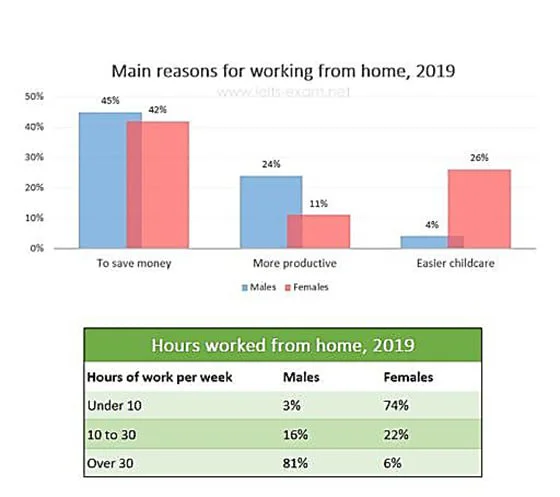
The bar chart and table compare the main motivations for working from home among men and women in 2019 together with the weekly hours they worked remotely. The data suggest a clear gender contrast: men were more likely to cite performance-related or financial reasons and tended to work long hours, whereas women were far more influenced by childcare and were concentrated in the lowest hour-category.
Regarding motivations, saving money was the most common reason for both genders, at 45% of men and 42% of women. However, productivity showed a sharper gender split: almost a quarter of men chose this reason, compared with only 11% of women. The opposite pattern appeared in childcare, where just 4% of men selected this factor, in stark contrast to the 26% of women who did so.
A similar divergence is visible in working hours. The vast majority of men—81%—worked more than 30 hours per week from home, and only tiny proportions fell into the lower brackets. Women displayed the reverse structure: nearly three-quarters worked fewer than 10 hours, while just 6% exceeded 30 hours. Mid-range hours (10 to 30) were relatively uncommon for both groups, though slightly more typical among women.