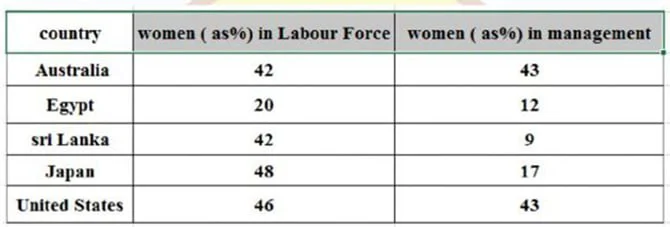
The table shows the representation of females in the labor force and managerial positions across five nations. The data suggest that while the rates for the Australian and American female workers and managers are indicative of overall gender equality, the figures in Sri Lanka, Japan, and, worst of all, Egypt reflect sharp inequalities. It is also noteworthy that women’s participation in higher positions generally lags behind their overall presence in the workforce.
In Australia, 42% of the workforce is comprised of women, compared to a figure that is one percentage point higher in executive positions, making this country the only nation where gender representation in management favors women. The US also has a balanced distribution, although the percentage of women in managerial roles was three points lower than the 46% of female workers.
However, the female job profile in the remaining countries varied greatly. In Egypt, female workers are the most underrepresented, at just 20%, with about half as much in higher positions. This was followed by Sri Lanka and Japan, where the percentage of female employees was nearly equal, at 42% and 48%, respectively, with the former having the highest figure. In stark contrast, in higher positions, these rates were significantly lower, indicating a strong underrepresentation, at 9% and 17%, respectively.