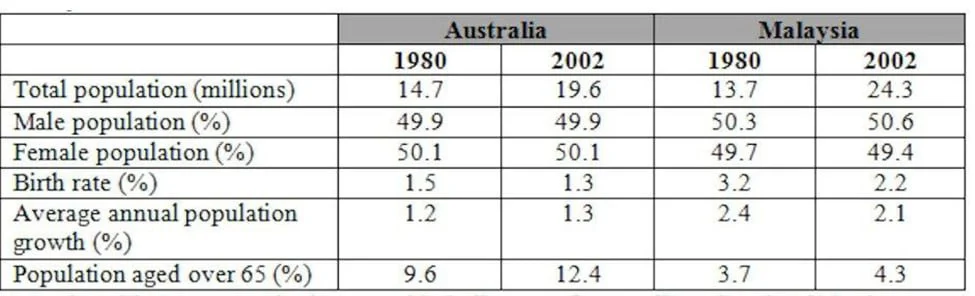
The table compares various demographic indicators for Australia and Malaysia in 1980 and 2002. The data show that Malaysia experienced faster population growth driven by higher fertility rates, while Australia had a significantly older population structure despite also increasing in size. Gender ratios, however, remained balanced and largely unchanged in both countries.
In terms of population size and growth, both countries expanded significantly, but Malaysia’s increase was more notable. Australia grew from 14.7 to 19.6 million people, while Malaysia’s population rose from 13.7 to 24.3 million. These differences align with their respective annual growth rates: Malaysia’s stayed above 2%, whereas Australia’s remained steady at 1.2–1.3%. It is also noteworthy that Malaysia’s total fertility rate was more than twice that of Australia in 1980 (3.2% versus 1.5%) and, despite a considerable decline, stayed higher in 2002 (2.2% versus 1.3%).
A different pattern appears in population makeup. The male–female balance in both countries stayed close to equal throughout the period, with no significant changes. In contrast, the proportion of older residents diverged notably. Australia had a much larger elderly population, increasing from 9.6% to 12.4%, while Malaysia’s figures were much lower, growing only from 3.7% to 4.3%.